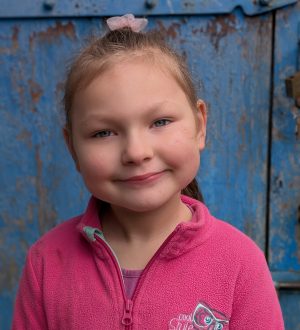
Dear Sponsor,
My name is Diana, and I am 7 years old. I live in a town. I don’t have a father, and my mom gets a disability pension. I have a sister named Sofiia, and she really loves rabbits.
Last year we had a whole family of rabbits. They were our friends, and we didn’t eat any of them.
I have a nice neighbor friend named Sasha. He is 4 years old. We like playing with toy cars and going for walks outside. At Christmas, I love decorating the Christmas tree and our house. We cook dinner together too. In the summer, when I don’t have holidays, I go to kindergarten. On weekends, I play outside and visit friends. I walk to kindergarten and stay there until evening. I like the songs we sing and that there are many children. The only thing I don’t like is sleeping during the day. We play a lot and get ready for school.
I like many kinds of food, especially borscht. At home, I usually eat soups, porridge, and pasta. On holidays, we don’t always have special food, but my mom tries to make a salad and sometimes bakes pies. In my free time, I like playing with toy dishes, drawing pictures, and walking the dog.
When I grow up, I want to be a cook and make tasty food for everyone.
Thank you very much for choosing me. I will be very happy to talk with you and will wait for your letter.
This letter was written by my mom because I cannot write yet.
Caseworker’s comments:
Diana is an energetic, curious little girl who fills every room with questions, chatter, and laughter. She loves people, shares her toys easily, and can entertain herself for hours with simple games. Kindergarten is one of her happiest places, and she tries her very best to succeed. Her favorite moments are walking the family dog, helping her mother wash dishes, and sweeping the yard. Even at her young age, she is gentle, caring, and surprisingly aware of the struggles her family faces. Because of their financial situation, Diana has never been able to receive a proper medical assessment. She reacts to many foods, and her development shows signs similar to her older sister’s disability, this is something that needs urgent examination by a specialist.
We first met this family through local social services, and from the very beginning it was clear that they were living in extremely difficult conditions, often without enough food. Diana’s mother, Maria, grew up in the same house. She had a loving upbringing from her grandparents and began attending a Baptist church at fourteen, choosing to follow God despite being mocked and forbidden to attend by her own family. At nineteen, she became pregnant. When she chose to keep her baby, her family rejected her, and she moved into an abandoned house belonging to a distant relative. The conditions were harsh, but Maria worked wherever she could—doing heavy labor in fields and at a sawmill—to survive. The father of her first daughter, Sofia, denied the child and later passed away, leaving Maria completely alone.
Diana was also born into a situation without a father. Her own father has fully withdrawn from the family and provides no support. Over the years, Maria’s health deteriorated severely. She now lives with lifelong disability, struggling with serious leg problems, obesity, psoriasis, and a rapid decline in mobility. Last year she could still walk to the store; today she can barely move between rooms. She cannot care for the home or the children the way she wants to, and she has no one who can stay with the girls if she were to seek medical treatment.
Sofia, the eldest daughter, has a confirmed intellectual developmental delay. She once studied at a boarding school but now attends a local school. Because of her mother’s condition, Sofia carries responsibilities far beyond her abilities—keeping the house in order, caring for Diana, and walking her to and from kindergarten every day. For a child with special needs, this burden is exhausting and unfair.
The family lives in an old house where the living conditions are extremely deplorable. There is no kitchen or indoor toilet. The roof leaks, and part of the ceiling is damaged. Most of the furniture is broken; the only bed, where Maria and both girls sleep, stands on bricks because its legs have rotted. Some windows are so old that cold air pours through them. The gas boiler is outdated and extremely expensive to run, and the family has unpaid debts for water and gas. Firewood has been delivered, but there is no one strong enough to chop it, so the girls cut it by hand when they can. The house once belonged to a hardworking grandfather who kept everything in order, but after his death it fell into neglect.
The summer kitchen is used year‑round for cooking. It has some wood‑burning stove and a gas stove, and in winter the fire must be kept burning constantly to prevent the pipes from freezing. There is running water and a boiler there, but no kitchen sink; dishes are washed in a basin. The sewage system is a cesspit that fills quickly, so the family conserves water, and Sofia often carries wastewater outside by hand. Inside the house, the family lives in a single room. Three people share one bed, and in warm weather Sofia sleeps on the floor. The hallway roof leaks badly, and the ceiling is damaged.
Their financial situation is heartbreaking. Maria receives a monthly disability pension of 2,700 UAH ($88 CAD) and child benefits of up to 8,000 UAH ($260 CAD), totaling about 10,700 UAH per month—roughly $340 CAD. This barely covers utilities, let alone food, clothing, hygiene supplies, or school materials. In winter, gas bills alone reach 6,000 UAH ($195 CAD), and electricity costs another 2,000 UAH ($65 CAD). The family simply cannot meet even their most basic needs.
Through all of this, Diana remains a bright, loving child who wants nothing more than to learn, play, and grow. She needs medical assessments, proper nutrition, stability, and a safe environment. Her mother needs support. Her sister needs support. Their home needs repairs. Their lives need hope.
This family urgently needs help through the HART’s Child Sponsorship Program. Sponsorship would give Diana and her sister access to essential resources, medical care, and the chance to grow up in dignity and safety. It would lift an impossible burden from their mother and allow the children to experience a future not defined by poverty or illness, but by hope, stability, and love.